
What Is the Scaling Blueprint?
The Scaling Blueprint is a four-stage advertising strategy designed to help you turn search term discoveries into profitable keyword targets and opportunities for organic growth.
Scale Insights’ preset Strategic Objectives apply different optimization strategies at each stage. Use them as a starting point and customize them to fit your campaigns, profit margins, and advertising goals.
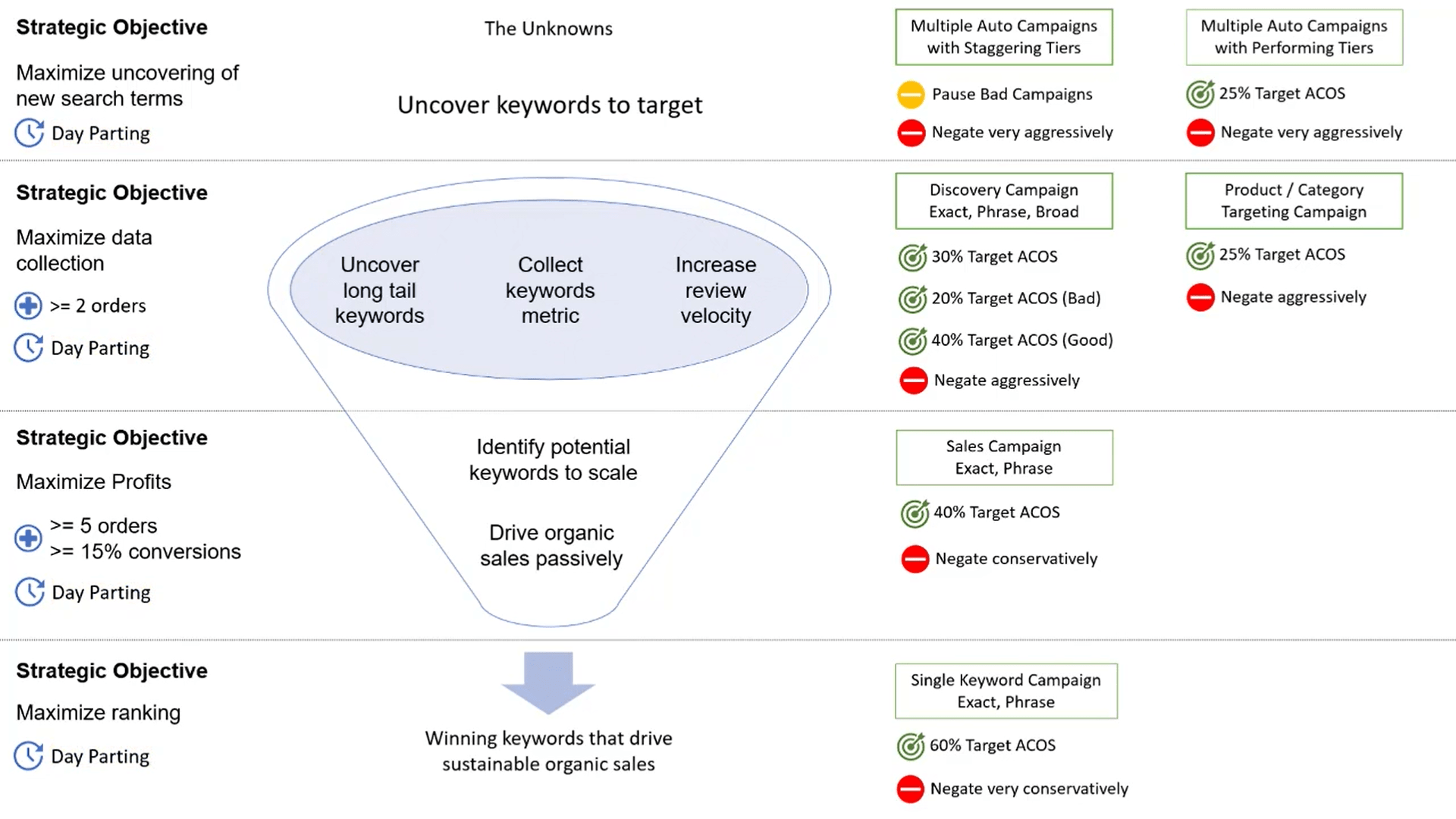
Our 8-figure advertising blueprint video outlines a 4-stage funnel.
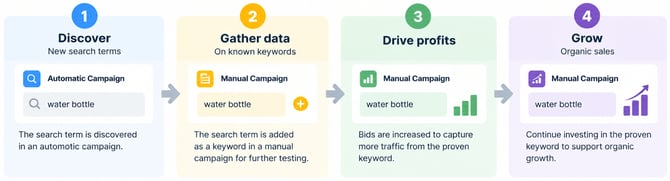
How a Search Term Progresses Through the Funnel
Consider a seller advertising a "reusable water bottle".
- Discover: The system identifies the search term “water bottle” through an automatic campaign.
- Gather data: Once the search term meets the configured criteria, it is added as a keyword in a manual campaign for further testing.
- Drive profits: If the keyword demonstrates strong sales and conversion performance, the system focuses on increasing profitable traffic.
- Grow organic sales: If the keyword continues to perform well and has organic growth potential, the system uses a strategy designed to support organic sales.
The goal is to move from discovering new opportunities to investing more deliberately in proven keywords.
Not every search term will progress through all four stages. Its progression depends on the configured Strategic Objectives, rules, and performance criteria.
Strategic Objectives for Each Stage
Some of the preset strategic objectives model after the funnel, where keywords move increasingly downward from stage 1 to stage 4, the better they convert.
Navigation: Automation > Strategic Objectives
[drawer]Stage 1: Discover New Search Terms with Bulk Auto
The first stage focuses on finding new search terms that could generate sales for your product.
Goal: Discover new keyword opportunities while gathering performance data.
How it works:
- Collect performance data across ads to identify promising search terms.
- Use aggressive negation to reduce spending on search terms that meet your negative targeting criteria.
- Identify search terms that may be worth testing as keywords in manual campaigns.
What this means for you: You can explore new opportunities while limiting wasted ad spend on unproductive search terms.
Strategic Objective:
[drawer]Stage 2: Gather Data on Known Keywords with Discovery Objectives
Once a search term generates a sale and meets the relevant criteria, it can be added as a keyword or target in a manual campaign for further testing.
Goal: Gather enough performance data to evaluate a keyword's potential.
How it works:
- Add qualifying search terms to manual campaigns.
- Explore longer, more specific keyword variations to discover additional opportunities.
- Use aggressive negation to limit spending on terms that do not meet your performance criteria.
- What this means for you: You can evaluate which keywords are worth investing in before committing more budget to them.
Strategic Objectives:
[drawer]Stage 3: Drive Profits with Sales Objectives
When a keyword demonstrates stronger sales and conversion performance, it can progress to Stage 3 for more focused optimization.
Goal: Increase profitable traffic from proven keywords.
How it works:
- Apply bid adjustments to capture more traffic from promising keywords.
- Use more conservative negation to avoid cutting off valuable traffic too quickly.
- Continue monitoring performance to ensure that additional traffic supports your profitability goals.
What this means for you: You can invest more confidently in keywords that have demonstrated their potential while protecting valuable traffic opportunities.
Strategic Objectives:
[drawer]Stage 4: Grow Organic Sales with Ranking Objectives
The final stage focuses on keywords with strong sales and conversion performance that may have the potential to improve organic rankings.
Goal: Support organic sales growth through targeted advertising.
How it works:
- Focus advertising investment on proven keywords with organic growth potential.
- Apply a more aggressive bidding and spending strategy where appropriate.
- Use very conservative negation to protect valuable keywords from being excluded too quickly.
What this means for you: You can focus on keywords that may help improve organic visibility while continuing to generate sales through advertising.
Strategic Objectives:
Keep in mind that advertising does not guarantee improvements in organic rankings. Results depend on multiple factors, including sales performance, competition, and product relevance.
Customizable strategies and rules
The four-stage funnel is a starting point, not a one-size-fits-all strategy.
While new accounts come with preset settings, the automation engine is agnostic and not hardwired to any particular advertising strategies.
The strategic objectives, rules, and trigger criteria are highly customizable, and you do not have to follow the funnel approach if your existing approach works well for you.
However, you can refer to them to understand how to use strategic objectives and rules to automate advertising strategies.
Before applying the preset objectives, consider the following:
- Campaign structure: Ensure your campaigns support the intended flow of search terms between stages.
- Product profit margin: Set bidding and spending rules that reflect how much you can afford to spend to acquire sales.
- Average CPC: Consider your typical cost per click when setting bid adjustments and spending limits.
- Advertising goals: Decide whether your priority is discovering new keywords, improving profitability, or supporting organic growth.
- Performance criteria: Review the conditions that trigger optimization actions and determine whether they align with your strategy.
Before making changes, review what each rule does and how it affects your campaigns. Start with adjustments that align with your goals, then monitor performance to determine whether further changes are needed.
What's Next?
Now that you understand the Scaling Blueprint, explore these guides to put the strategy into practice:
- How to Automate Your Ads — Learn how to set up automation for your ad groups.
- Overview of Each Automation Algorithm — Understand the available algorithms and how they support your advertising strategy.
- Using Strategic Objectives — Learn how to create, edit, and assign Strategic Objectives.
- How to Create and Customize Automation Rules — Learn how to create and edit rules.
- How to Create and Use a Criteria Profile — Learn how to create and edit criteria.